Thursday, August 11, 2011

Summer vacation 2011 - Kochi

After stopping by Oozu, we continued on our way towards Kochi. Along the way, we passed by Mezurudaira (姫鶴平), part of Shikoku Karst (四国カルスト). It was partly covered by the clouds,  so you can imagine up a difficult drive it was to get there (and down). The roads were narrow and windy, and it was hairy passing on-coming traffic.

Mezurudaira happens to make the border between Iyo (present day Ehime prefecture) and Tosa (present day Kochi prefecture).

And here are some Tosa cows grazing away.

The way to Kochi from Oozu was tedious... the roads were narrow and windy, and the on-coming traffic was speeding along the mountain roads at high speeds as they were used to it, unlike me, a first time traveller along those roads. There were a few times in which I had to pull over and stop the car so that on-coming traffic can go first (the road was too narrow for two vehicles to pass by each other) and we were inches apart. A wrong move and I would have rolled down the side of the mountain, or get flattened against the cliff by a trailer truck. After almost 5 hours of driving from Oozu, we finally reached Kochi, and a sumptous dinner was waiting for us!

We were also fortunate to have a nice view of Kochi Castle from our room.


Kochi is the birthplace of Sakamoto Ryouma (坂本龍馬), a samurai who helped engineered the Meiji Restoration. We took the next day to explore the town, visiting a museum dedicated to him.


Of course, who can miss visiting Kochi Castle?

During our visit, we coincidentally met the Yosakoi Matsuri, which explained the long line of decorated trucks lining the roads. These trucks provide the music for their respective troupes.


At Kochi Castle itself, there was even a nation-wide competition to decide the best Yosakoi troupe.

Wednesday, August 10, 2011

Summer vacation 2011 - Oozu

Our next stop on the trip was Oozu (大洲), which was a short drive from Dougo Onsen. Okay, not that short a drive, but still short comparing to where we were going after that. The original plan was to drive from Dougo Onsen to Ashizuri Misaki (足摺岬) and then to Kochi (where we were spending the night) but it was too long a drive to be accomplished in one day, so we gave up the idea, and instead decided to go straight from Dougo Onsen to Kochi, stopping by Oozu along the way.

Our first stop at Oozu was Garyu Sansou (臥龍山荘), a beautiful retreat built during the Edo period. The rooms were beautifully decorated and created to give a sense of the seasons, and the garden was beautifully created.


There was even a natural fridge dug into the cliff.

The next stop at Oozu was of course the castle itself. Oozu Castle was rebuilt in 2004 based on old photographs.

And here is the little ninja wannabe, trying to scale the castle walls...

And he doesn't give up, here he is again climbing up the steep stairs inside the castle.

This postbox in Oozu is famous for being the one used in the filming of "Tokyo Love Story".

Tuesday, August 09, 2011

Summer vacation 2011 - Dougo Onsen

After our brief stop at Etajima, we made our way towards our next destination, Dougo Onsen (道後温泉). We took a ferry from Etajima to Kure, and then another ferry from Kure to Matsuyama. Here we are on the two ferries.


There was a Ghibli Studios shop here selling toys from animation like "My Neighbour Totoro". I guess the shop is here because the animation "Spirited Away" was based on the hot spring at Dougo Onsen.

You can see how much resemblance there is.

And this is the hot spring at night.

There is also an animated clock here that puts up a short display every hour (every 30 minutes during summer).

Here's the little kid enjoying his cup of green tea after a soak in the hot spring.


Summer vacation 2011 - Etajima

It was the 66th anniversary of the atomic bombing of Nagasaki, but instead of visiting the city, we made a brief stop was made at Etajima, home of the old Imperial Japanese Naval Academy, and presently being occupied by Japan Maritime Self-Defense Force's Maritime Officer Candidate School. This is the birthplace of Japan's naval officers.

Part of the education includes self-reflection using the Five Reflections (五省).

Here's the little kid standing on the stage in the main hall, which is used for ceremonies.

Monday, August 08, 2011

Summer vacation 2011 - Hagi

Our hosts brought us to Hagi, a place famous for producing prime ministers as well as many of the brains of the Meiji Restoration. While Hagi Castle is no more, there are still remnants of the castle, such as this portion of the north gate.

Hagi also has many buildings built during the Edo and Meiji periods.


These old houses have beautiful gardens.

One of the figures of the Meiji Restoration is Takasugi Shinsaku, and he is still remembered today with his statue here.

Another figure of the Meiji Restoration was Kido Takayoshi, and we visited his old house.

It is amazing that this small town produced many prominent figures... back not so if you know why. Yoshida Shoin set up his school, Shoka Sonjuku, in Hagi and taught many of these prominent figures. Today, the school is part of a larger shrine dedicated to Yoshida Shoin.

The remains of Shoka Sonjuku.

The Shoin Shrine, dedicated to Yoshida Shoin.

Sunday, August 07, 2011

Summer vacation 2011 - Akiyoshi Caves

After leaving Hiroshima, we set off for Akiyoshi (秋吉).

On the way, we stopped by a service area on the expressway near Miyajima. It brought back memories of running up and down Mount Misen, the highest peak on the island. And of course, the huge red torii gates of Itsukushima Shrine is what Miyajima is famous for.

Akiyoshi Caves is a set of limestone caves, running about 1km in length. It was quite a walk, but the view inside was impressive. And of course, somehow, the temperature was cool too! Very much different from the summer heat.


We also manage to drive through Akiyoshidai, a plateau with uplifted reef limestones.

Saturday, August 06, 2011

Summer vacation 2011 - Hiroshima

We started our summer vacation at Hiroshima on the 66th anniversary of the atomic bombing of the city, very much by coincidence. It was never our plan to visit the city on the anniversary, and I only came to realise that we would be visiting on the anniversary a day before departure.

But since we were in the city, we took the opportunity to take part in the events that were taking place. Like praying for world peace.

And writing our wishes for peace on a paper lantern and setting it down the river, together with everyone else.

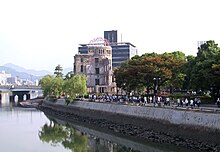
Of course, a visit to Hiroshima is never complete without a picture of the Hiroshima A-bomb Dome.

66 years after Hiroshima

Today marks the 66th anniversary of the bombing of Hiroshima, and we are off to visit the city.

Tuesday, August 02, 2011

Open to immigrants

Maritime nations like the US (and the British Empire of old) had policies that welcome immigrants, and I see that as a source of their power. By being open to immigrants, nations are able to fulfill their workforce requirements (not just the brains but also the brawn) to allow continued economic growth. This is especially pressing given that developed nations tend to have a demographic structure that is top heavy (look at Japan now). Singapore's history is weaved intricately with an immigrant society that eventually gave birth to one of the world's leading ports. But we must not forget that, as with all developed nations, we will face the top-heavy demographic structure eventually, and the key to continued economic growth may well be found in our history. Japan is facing the problems of an aging society and workforce now. Let's see how her immigration policies (whatever form and direction they take) affects her economic future, and see if we can draw some lessons from them before it is too late for us.